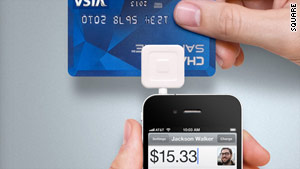
 According to this CNN article, Twitter co-founder Jack Dorsey has created an application called Square, which uses a free download and plastic card reader to let users accept credit card payments. The app charges users 2.75 percent of the transaction cost plus a 15-cent fee, which is similar to fees stores have to pay for accepting credit cards. Dorsey says that because no one carries around cash anymore, just plastic, this app will help create more money and more volume. The app is available for several phones including Google's Android system, Droid, Droid X, HTC Evo, Samsung Galaxy S, the iPhone, iPad and iPod Touch. Dorsey said that this app will help small independent merchants as well as fundraisers. The app is no available for download at Square's website.
Wednesday, October 27, 2010
Smartphonne Doubling as Cash Register
According to this CNN article, Twitter co-founder Jack Dorsey has created an application called Square, which uses a free download and plastic card reader to let users accept credit card payments. The app charges users 2.75 percent of the transaction cost plus a 15-cent fee, which is similar to fees stores have to pay for accepting credit cards. Dorsey says that because no one carries around cash anymore, just plastic, this app will help create more money and more volume. The app is available for several phones including Google's Android system, Droid, Droid X, HTC Evo, Samsung Galaxy S, the iPhone, iPad and iPod Touch. Dorsey said that this app will help small independent merchants as well as fundraisers. The app is no available for download at Square's website.

Monday, October 25, 2010
Blog Prompt 3: Revolution, Facebook style
I believe social networking sites have become so popular amongst authoritarian states because it is the only medium in which risk for getting caught criticizing the government is at its lowest. Social networks are not physical, like sidewalks, which people use (at least in the U.S.) to protest happenings in their nation; unlike on a sidewalk where you can get picked up by the police, there is no online police to silence you. It is also much more difficult to silence those using social networks as outlets to speak out. In order to silence people, governments would have to block entire websites from its citizens or individual pages, which calls for time and money; on top of that, the government would have to use technology to trace whoever is posting these comments. Whereas these actions take much effort by the government, silencing people outside making their comments known in public is easy as arresting someone and taking them to jail.
I think social networking sites are being used for politics here in the U.S., but I don't believe they're being used for the same reasons as those in authoritarian states. In the U.S., people can demonstrate free speech physically almost anywhere, so citizens using the Internet to do the same is really no different. The government is not oppressive to its citizens; it does not silence them. Instead, if anything, social networks are being used to increase participation in politics. Politicians running for office may use different sites as part of their campaign in hopes of reaching a larger audience, which is completely opposite to authoritarian countries.
I think social networking sites are being used for politics here in the U.S., but I don't believe they're being used for the same reasons as those in authoritarian states. In the U.S., people can demonstrate free speech physically almost anywhere, so citizens using the Internet to do the same is really no different. The government is not oppressive to its citizens; it does not silence them. Instead, if anything, social networks are being used to increase participation in politics. Politicians running for office may use different sites as part of their campaign in hopes of reaching a larger audience, which is completely opposite to authoritarian countries.
Tuesday, October 19, 2010
Smartphone or a car? Or both?
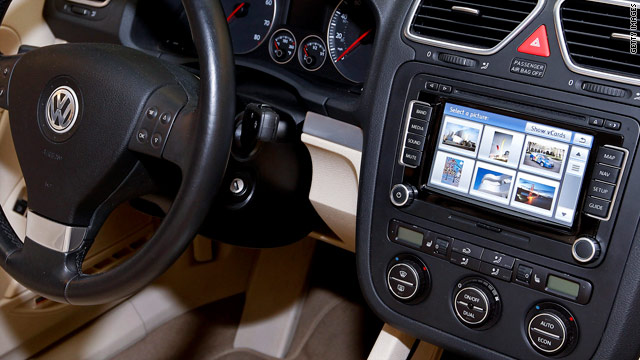
According to this article, many auto and electronic companies are working towards a touch screen system inside cars that allows drivers to talk, text, use Facebook and surf the web right through the dashboard. A large percentage of cars in the future will allow for drivers to update their Facebook statuses by voice and even surf the web from the driver's seat. The main purpose that drives these new systems are for drivers to be able to use their smart phone capabilities in a safer setting while driving.
 The car company Ford plans on presenting "App Link," which is "a voice-control system that links apps from the user's smartphone to the car in some models." This technology could be available in 80 percent of Ford vehicles within the next five years. Other companies are too follow this suit. General Motors is incorporating smart phone capabilities into the On-Star feature, and Kia Motors and Microsoft teamed up to launch UVO, "a touchscreen and voice-enabled system that lets drivers make calls, send text messages, change radio stations and scroll their music playlists."
Though the production of these system is to make driving safer for those already using such applications on their phones while driving, distracted driving is still distracted driving whether or not the distraction is in your hand or built into your car.
 The car company Ford plans on presenting "App Link," which is "a voice-control system that links apps from the user's smartphone to the car in some models." This technology could be available in 80 percent of Ford vehicles within the next five years. Other companies are too follow this suit. General Motors is incorporating smart phone capabilities into the On-Star feature, and Kia Motors and Microsoft teamed up to launch UVO, "a touchscreen and voice-enabled system that lets drivers make calls, send text messages, change radio stations and scroll their music playlists."
Though the production of these system is to make driving safer for those already using such applications on their phones while driving, distracted driving is still distracted driving whether or not the distraction is in your hand or built into your car.
Wednesday, October 13, 2010
Google TV
According to this article, Sony is releasing their newest line of TVs, which use the Google TV software. The Internet HDTVs come with four USB ports, four HDMI inputs and Wi-Fi. The smallest the model, the 24", costs $599 whereas the largest, the 46" costs $1,399.
The Internet TV software carries Hulu, Twitter, Netflix, YouTube, Pandora, search capabilities and some Android apps. Web browsing on the TV is powered by Google Chrome and the apps are powered by Android OS.
The main intent of the new TV is to integrate the web with existing cable or satellite TV in order to make it easier to search for favorite TV shows and websites at the same time. Google seems to spreading its success past the Internet world and into living rooms. The TVs are for sale on SonyStyle.com starting this Saturday and in Best Buy stores Sunday.
If the TV itself doesn't seem complex enough, take a look at the remote needed to operate it.

The Internet TV software carries Hulu, Twitter, Netflix, YouTube, Pandora, search capabilities and some Android apps. Web browsing on the TV is powered by Google Chrome and the apps are powered by Android OS.
The main intent of the new TV is to integrate the web with existing cable or satellite TV in order to make it easier to search for favorite TV shows and websites at the same time. Google seems to spreading its success past the Internet world and into living rooms. The TVs are for sale on SonyStyle.com starting this Saturday and in Best Buy stores Sunday.
If the TV itself doesn't seem complex enough, take a look at the remote needed to operate it.

Saturday, October 2, 2010
Jimmy Fallon Hip Hop History
I was listening to a talk show the radio the other morning while driving to school when the host started talking about last night's episode of Late Night with Jimmy Fallon. Apparently, Jimmy Fallon and Justin Timberlake performed a duet of a history of hip hop music, which obviously made a buzz. After explaining what happened on last night's show, the radio station played the entire three minute sound bite of the show on the radio.
Though I heard the entire clip, I wanted to see it too. So, after having listened to the radio while listening to a TV clip, I found the clip on YouTube so I could both see and hear it. And, if I really wanted to, I could have found the entire Jimmy Fallon episode on my TV because I have DVR and record the show every night anyway. But instead, I'm choosing to blog about it.
It's interesting how one 3 three minute clip can travel in so many mediums in so little time. But it's also not surprising how little videos like this create such a buzz within hours of them airing.
Though I heard the entire clip, I wanted to see it too. So, after having listened to the radio while listening to a TV clip, I found the clip on YouTube so I could both see and hear it. And, if I really wanted to, I could have found the entire Jimmy Fallon episode on my TV because I have DVR and record the show every night anyway. But instead, I'm choosing to blog about it.
It's interesting how one 3 three minute clip can travel in so many mediums in so little time. But it's also not surprising how little videos like this create such a buzz within hours of them airing.
Subscribe to:
Posts (Atom)